Robotic Palletizing Systems: Types, Applications, and How to Choose
Your production line shouldn’t be limited by how many people you can get to lift and stack at the end of it.
Robotic palletizing can turn a repetitive, physically demanding job into a consistent, scalable process. One that helps you move more product, build uniform loads, and put your team to work where their judgment and skill matter more.
But delivering those gains takes more than just installing a robot arm.
A successful palletization system has to account for your product, throughput, SKU mix, pallet patterns, and more. In other words, it needs to fit your operation and be part of your larger productivity strategy.
Byron Automation has designed and integrated palletizing systems for manufacturers, food and produce processors, and distribution operations facing complex product-handling and material-flow challenges.
In this guide, we’ll explain the main types of palletizing systems, what they can handle, and the factors that tell you which approach will deliver the best results for your operation.
What Is a Robotic Palletizing System?
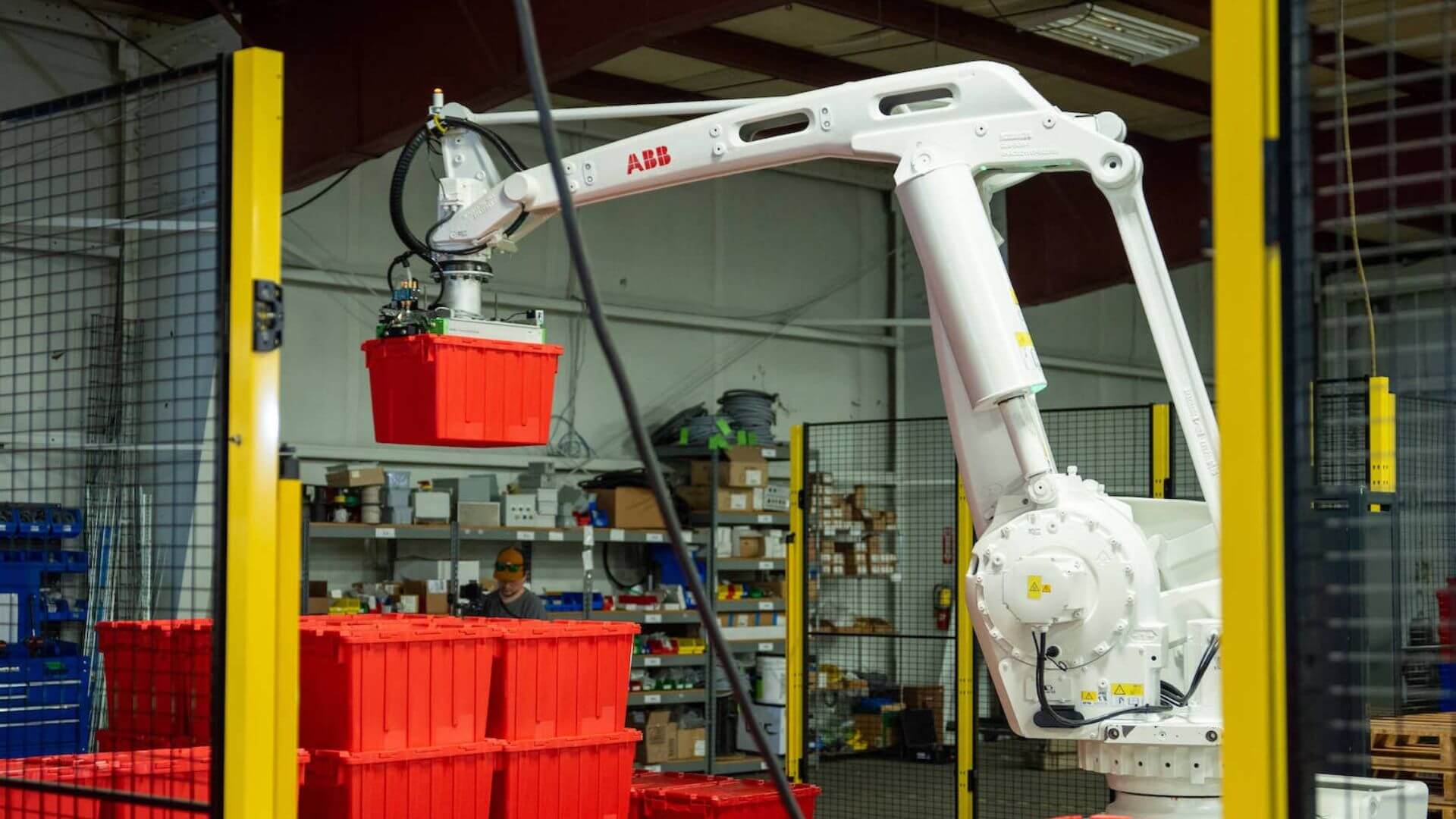
Robotic palletizing uses a robot to pick products from a conveyor or staging area and arrange them on pallets for storage or shipment. Depending on the application, it may handle cases, bags, trays, totes, containers, or other packaged goods.
But the robot is only the most visible part of the system. A complete robotic palletizing cell may also include:
- End-of-arm tooling
- Infeed and accumulation conveyors
- Empty-pallet and dunnage handling
- Safety systems
- Controls and an operator interface
- Full-pallet removal or downstream equipment
The Association for Advancing Automation similarly describes robotic palletizing as an integrated process involving the robot, product flow, pallet patterns, and surrounding equipment.
What Are the Main Types of Palletizing Systems?
The best approach depends on the product, required rate, variability, available space, and plans for the operation.
Industrial Robotic Palletizers
Industrial articulated robots can handle demanding production rates, substantial payloads, multiple pallet positions, and complex motion. They can often accommodate different products and patterns through programmed recipes and purpose-built tooling.
These systems typically require fixed installation and appropriately designed safeguarding. Their flexibility makes them a strong option when an operation has multiple SKUs, changing patterns, unusual products, or several lines feeding a shared palletizing area.
Collaborative Robot Palletizers
Collaborative robots may suit lower-rate applications involving lighter products and a smaller working area. They can sometimes offer a more compact and accessible entry point into palletizing automation.
“Collaborative” doesn’t mean that a system is automatically safe to operate without guarding. The complete application, tooling, product, speed, and potential hazards still need to be assessed.
Gantry and Conventional Palletizers
Gantry systems move along fixed linear axes and can be effective for large working areas or heavy loads. Conventional palletizers generally form and transfer complete layers mechanically rather than placing individual products with an articulated robot.
Conventional systems can perform well in high-volume operations with stable products and patterns. Robotic systems tend to offer more flexibility when products, layouts, or pallet configurations change.
What Products Can Robotic Palletizers Handle?
Robotic palletizers can be designed for many kinds of products, but feasibility depends on more than weight and dimensions.
A case with a flat, rigid surface presents a different tooling challenge than a porous bag, flexible package, open tray, or irregular container. Engineers also need to understand the product’s center of gravity, surface condition, acceptable gripping pressure, orientation, and behavior during acceleration.
The right question isn’t simply, “Can a robot lift it?” It’s, “Can the complete system handle it reliably at the required rate without damaging the product or creating an unstable load?”
Seven Factors That Determine the Right System
1. Product and Packaging Characteristics
Start with representative products rather than ideal specifications. Account for dimensional variation, weight, rigidity, seams, openings, surface texture, and acceptable handling pressure.
If packaging changes by supplier, season, or SKU, that variability should be documented early.
2. Required Throughput
A robot’s theoretical cycle time isn’t the same as sustained system throughput. Real performance also depends on product spacing, pallet exchanges, pattern complexity, conveyor flow, dunnage placement, and downstream availability.
Define the normal rate, peak rate, operating schedule, and likely future requirement. That helps prevent a system from being designed for an incomplete picture of production.
3. SKU and Pallet-Pattern Variability
How many products and patterns must the system manage? Will products arrive in batches or intermixed? How often will operators change recipes?
A system built for one consistent case is different from one that must handle multiple dimensions, patterns, pallet sizes, or work orders. Future products matter too. A narrowly designed system can become a constraint as the operation changes.
4. Product and Pallet Flow
The robot needs a dependable supply of correctly presented products—and somewhere for completed pallets to go.
The design may need to account for accumulation, product orientation, empty-pallet delivery, dunnage, completed-load removal, stretch wrapping, forklifts, or autonomous mobile robots. If those surrounding processes can’t support the required rate, a faster robot won’t solve the problem.
5. Available Space
Floor space is only part of the layout. Engineers also need to consider ceiling height, robot reach, safeguarding, operator movement, maintenance access, electrical equipment, conveyors, and forklift traffic.
A thoughtful layout should solve today’s problem without unnecessarily limiting future expansion.
6. End-of-Arm Tooling
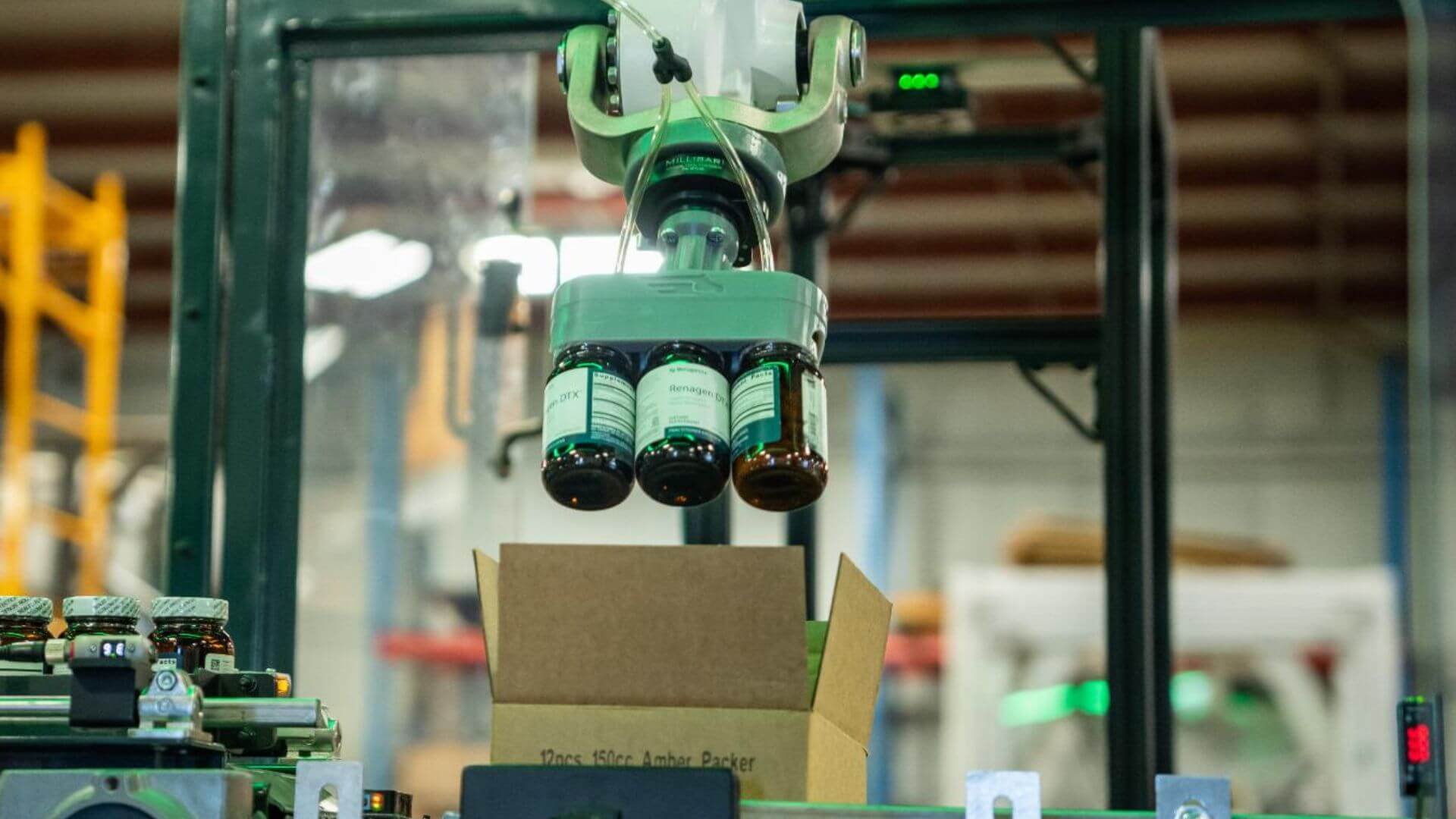
End-of-arm tooling is the robot’s point of contact with the product. It may use vacuum, clamps, forks, mechanical grippers, full-layer tooling, or a custom combination.
Tooling affects what the system can handle, how quickly it can move, and whether one robot can manage multiple products. Its weight also counts against the robot’s available payload.
7. Controls, Safety, and Maintenance
The palletizer must communicate with upstream and downstream equipment, provide operators with useful information, and recover safely from expected faults.
Safety and maintenance access should be considered from the beginning rather than added after the mechanical layout is finished. The current ISO 10218-2 standard addresses the integration, commissioning, operation, and maintenance of industrial robot applications, but the appropriate safeguards depend on the complete system and its hazards.
How Should You Evaluate the Business Case?
The business case should examine the complete operational effect of the system—not just the cost of the robot.
Relevant inputs may include current staffing, overtime, production hours, throughput constraints, injury exposure, product damage, maintenance requirements, and the value of additional capacity. It should also account for supporting equipment, engineering, installation, training, and expected service needs.
Avoid relying on a universal payback estimate. Two facilities handling the same product may have very different rates, staffing models, layouts, and automation requirements. A credible estimate needs to be based on your operation.
Why Complete-System Testing Matters
A palletizing system should be tested with representative products and realistic production conditions before it reaches the plant floor.
That means confirming more than whether the robot can complete a pick. Testing should examine sustained throughput, pallet exchanges, product variation, different patterns, expected faults, operator interaction, and communication among the system’s components.
Byron’s automation development process includes building and testing systems with the client’s production materials, correcting issues uncovered during testing, and running at full capacity for acceptance before deployment. This reduces the number of unknowns that have to be resolved onsite.
A Multi-Position Palletizing Example
For a grocery fulfillment operation, Byron developed a six-position robotic palletizing system that handles logistics totes and integrates with the facility’s existing fulfillment process.
The project illustrates why palletizing is often a material-flow challenge as much as a robot application. The system has to coordinate incoming totes, separate work orders, empty pallets, completed loads, and the surrounding warehouse operation.
What Should You Bring to an Initial Palletizing Conversation?
You don’t need a completed specification before speaking with an integrator. It helps, however, to gather:
- Representative product samples and specifications
- Required and peak production rates
- SKU, pallet, and pattern information
- A facility layout or basic measurements
- A description of the current process
- Known constraints and future production plans
Those inputs give the engineering team a more accurate starting point for evaluating feasibility and developing a concept.
Frequently Asked Questions
How much does a robotic palletizing system cost?
Cost depends on the robot, tooling, conveyors, pallet handling, controls, safeguarding, engineering, installation, and testing required. A useful estimate can only be developed after the complete application is understood.
How much space does a robotic palletizer need?
The required footprint depends on the robot’s reach, number of infeed and pallet positions, product flow, safeguarding, maintenance access, and full-pallet removal. A layout should account for surrounding operations as well as the robot cell itself.
What’s the difference between robotic and conventional palletizing?
Robotic palletizers generally place products using a programmable robot and can offer greater flexibility across products and patterns. Conventional palletizers use mechanical equipment to form and transfer layers and may suit very high-volume, stable applications.
Can a robotic palletizer connect to an existing line?
Often, but the integrator needs to evaluate product presentation, line controls, available accumulation, layout, safety, and downstream capacity. The existing line may also require changes to support reliable automated flow.
Can robotic palletizers handle unusual products?
Potentially. Irregular, flexible, porous, fragile, or otherwise difficult products may require custom tooling, testing, and changes to how the product is presented. Representative samples are essential for evaluating feasibility.
Start With the Operation
A successful palletizing system isn’t defined by the robot brand or an impressive demonstration. It’s defined by how reliably the complete system performs in your operation.
Byron is a full-service robotics and automation integrator with mechanical, electrical, controls, software, machine-vision, and tooling expertise on staff. If palletizing is part of your automation roadmap, bring us the application and let’s explore what’s possible.
Related Resources
Explore our latest articles and videos for insights on smarter, more strategic automation.
Collaborate On Advanced Productivity And Efficiency
Get in touch with one of our experienced engineers to begin the collaboration process.
Website Built By RUSTY GEORGE.